Daily Life at Utica Normal & Industrial Institute, an HBCC · 1903–1942
· · · ✦ · · ·
Originally edited by William H. Holtzclaw & the Utica Institute Community Critical edition edited by Patrick Sullivan, Daniel Fuller, Howard Tinberg & Apryl Trimble
Critical Edition
Southern Notes
Daily Life at Utica Normal & Industrial Institute, an HBCC
Cover Image
— Placeholder —
To Be Replaced
1903 — 1942
University Press of Mississippi
Forthcoming
Southern Notes: A Critical Edition
Vol. 1 (1903) — Vol. 39 (1942)
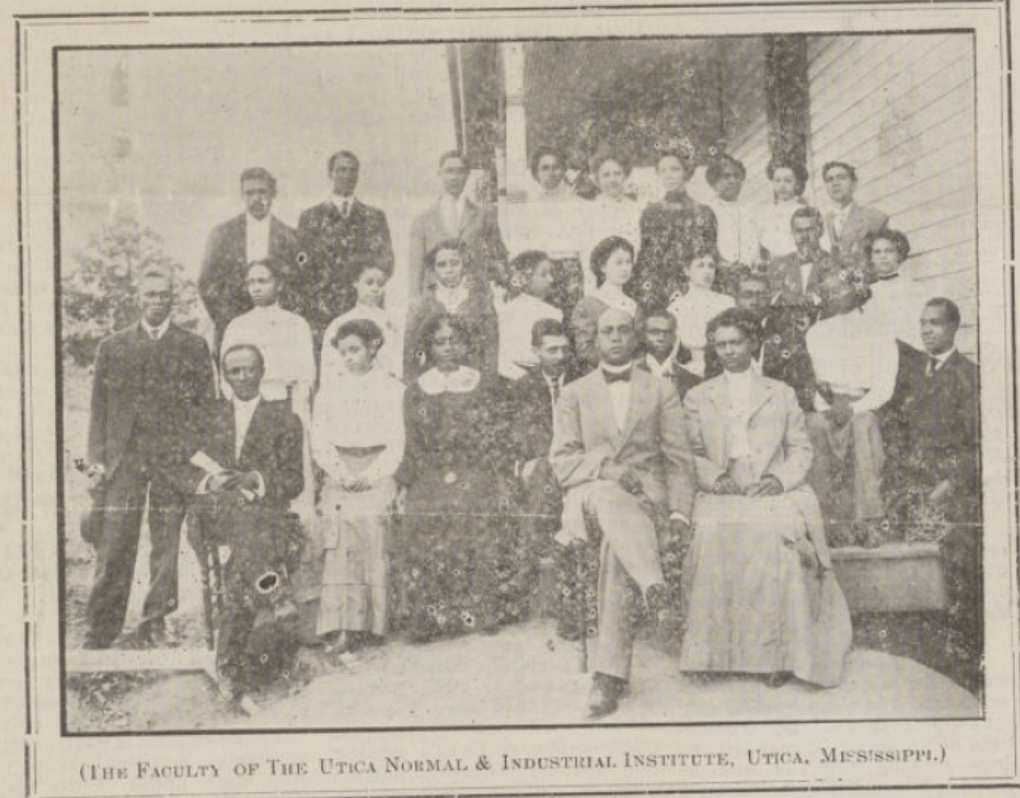
Southern Notes was the newsletter of the Utica Normal and Industrial Institute in Utica, Mississippi — a historically Black college founded by William Henry Holtzclaw in 1903.
Published continuously for nearly four decades, the newsletter documented the rhythms of campus life, agricultural and industrial education, fundraising efforts, and the broader struggle for Black self-determination in the Jim Crow South.
This critical edition presents Southern Notes with editorial introductions, contextual annotations, and an archive of primary sources.
Southern Notes was begun in 1903, as one of two monthly newsletters by the Utica Normal and Industrial Institute: Southern Notes was written for supporters of the institution around the country, while the Utica News was for students, alumni and the local community. For nearly four decades Southern Notes captured everything from construction of new buildings and sewing room donations to the daily struggle against inequality in Jim Crow Mississippi.
In this collection, we find accounts of the day-by-day challenges and victories of this "little Tuskegee" in rural Mississippi. This edition seeks to recover that record in full.
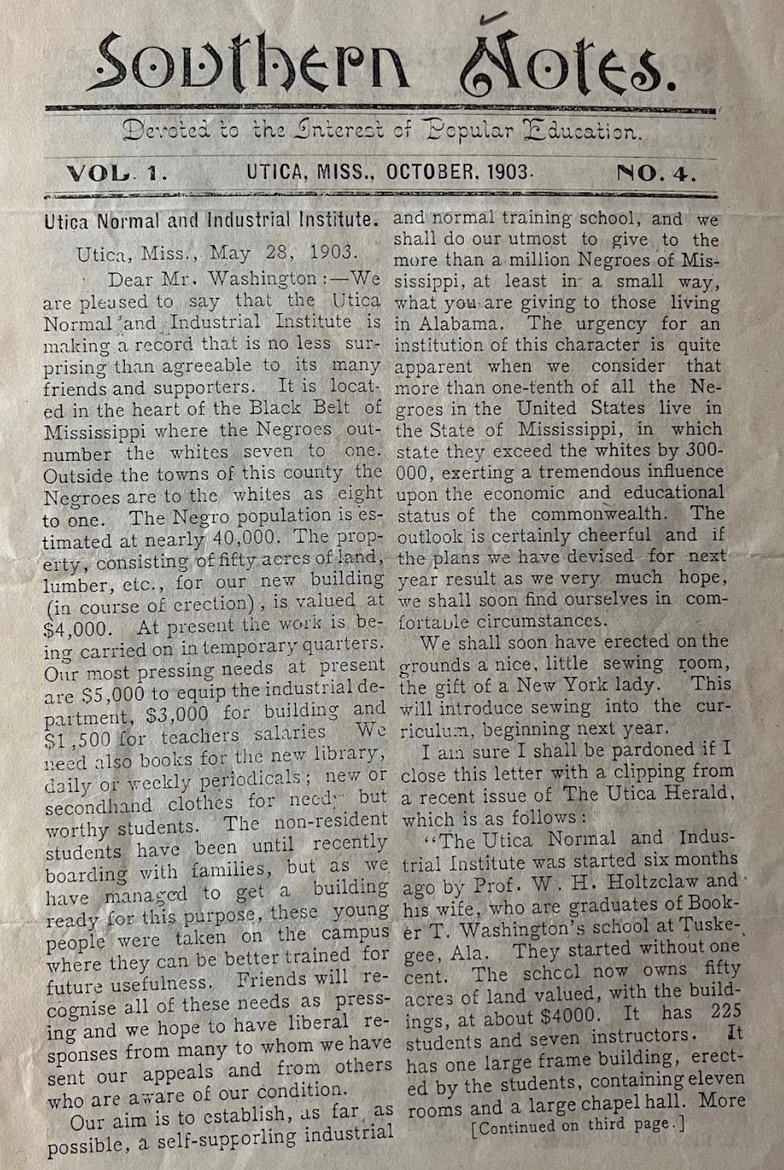
"Our aim is to establish, as far as possible, a self-supporting industrial and normal training school." — W. H. Holtzclaw, 1903
Issue Archive
A catalogue of all known issues of Southern Notes, with their holding institutions. Archive locations will be updated as digitization efforts continue.
1903 — 1910
Vol.
No.
Date
Archive / Location
1
4
October, 1903
Gutman Library, Harvard University
1
5
January, 1904
Gutman Library, Harvard University
3
2
November, 1904
Gutman Library, Harvard University
3
4
February, 1905
Gutman Library, Harvard University
3
7
May, 1905
Gutman Library, Harvard University
4
7
May, 1906
Schomburg Center, New York Public Library; Tulane University Library
4
8
June, 1906
Gutman Library, Harvard University
5
6
February, 1907
Schomburg Center, New York Public Library
5
8
April, 1907
Gutman Library, Harvard University; Schomburg Center, New York Public Library
5
8
April, 1908
Gutman Library, Harvard University
5
9
May, 1908
Gutman Library, Harvard University
5
10
June, 1908
Gutman Library, Harvard University; Schomburg Center, New York Public Library
6
11
July, 1908
Gutman Library, Harvard University; Schomburg Center, New York Public Library
6
12
August, 1908
Gutman Library, Harvard University; Schomburg Center, New York Public Library
7
1
September, 1908
Gutman Library, Harvard University
7
2
October, 1908
Gutman Library, Harvard University; Schomburg Center, New York Public Library
7
4
December, 1908
Gutman Library, Harvard University; Schomburg Center, New York Public Library
7
5
January, 1909
Gutman Library, Harvard University; Schomburg Center, New York Public Library
7
6
February, 1909
Gutman Library, Harvard University; Schomburg Center, New York Public Library
7
7
March, 1909
Gutman Library, Harvard University
7
8
April, 1909
Gutman Library, Harvard University
7
9
May, 1909
Gutman Library, Harvard University
7
10
June, 1909
Gutman Library, Harvard University
7
11
July, 1909
Gutman Library, Harvard University
7
12
August, 1909
Gutman Library, Harvard University
8
2
October, 1909
Gutman Library, Harvard University
8
3
November, 1909
Gutman Library, Harvard University
8
4
December, 1909
Gutman Library, Harvard University
8
5
January, 1910
Gutman Library, Harvard University
8
6
February, 1910
Gutman Library, Harvard University
8
7
March, 1910
Gutman Library, Harvard University
8
8
April, 1910
Gutman Library, Harvard University
8
9
June, 1910
Gutman Library, Harvard University
8
10
July, 1910
Gutman Library, Harvard University
8
11
August & September, 1910
Gutman Library, Harvard University
8
1&2
October & November, 1910
Gutman Library, Harvard University
1911 — 1920
Vol.
No.
Date
Archive / Location
8
4
January, 1911
Gutman Library, Harvard University
8
6
March, 1911
Gutman Library, Harvard University
8
7
April, 1911
Gutman Library, Harvard University
8
8
May, 1911
Gutman Library, Harvard University
8
10?(9)
June, 1911
Gutman Library, Harvard University
8
11
August, 1911
Gutman Library, Harvard University
8
12
October, 1911
Gutman Library, Harvard University
9
5
January, 1912
Gutman Library, Harvard University
9
6
February, 1912
Gutman Library, Harvard University
9
8
April, 1912
Gutman Library, Harvard University
9
9
May, 1912
Gutman Library, Harvard University
9
10
June, 1912
Gutman Library, Harvard University
9
12
August, 1912
Gutman Library, Harvard University
10
2
October, 1912
Gutman Library, Harvard University
10
4
December, 1912
Gutman Library, Harvard University
10
7
March, 1913
Gutman Library, Harvard University
10
9
May, 1913
Gutman Library, Harvard University
10
10
June, 1913
Gutman Library, Harvard University
10
11
July, 1913
Gutman Library, Harvard University
11
1
September, 1913
Gutman Library, Harvard University
11
2
October, 1913
Gutman Library, Harvard University
11
4
December, 1913
Gutman Library, Harvard University
11
5
January, 1914
Gutman Library, Harvard University
11
6
February, 1914
Gutman Library, Harvard University
11
7
March, 1914
Gutman Library, Harvard University
11
9
May, 1914
Gutman Library, Harvard University
11
10
June, 1914
Gutman Library, Harvard University
11
12
August, 1914
Gutman Library, Harvard University
11
13
September, 1914
Gutman Library, Harvard University
12
4
November, 1914
Gutman Library, Harvard University
13
6
February, 1915
Gutman Library, Harvard University
13
7
March, 1915
Gutman Library, Harvard University
13
7
April, 1915
Gutman Library, Harvard University
13
8
May, 1915
Gutman Library, Harvard University
13
9
June, 1915
Gutman Library, Harvard University
13
10
July, 1915
Gutman Library, Harvard University
13
11
August, 1915
Gutman Library, Harvard University
11
2
October, 1915
Gutman Library, Harvard University
12
3
November, 1915
Gutman Library, Harvard University
11
6
February, 1916
Gutman Library, Harvard University
11
8
April, 1916
Gutman Library, Harvard University
11
9
May, 1916
Gutman Library, Harvard University
11
12
August, 1916
Gutman Library, Harvard University
11
13
October, 1916
Gutman Library, Harvard University
13
5
January, 1917
Gutman Library, Harvard University
13
6
February, 1917
Gutman Library, Harvard University
13
9
June, 1917
Gutman Library, Harvard University
13
10, 11
July and August, 1917
Gutman Library, Harvard University
13
12
September, 1917
Gutman Library, Harvard University
14
1
November, 1917
Gutman Library, Harvard University
14
3
December, 1917
Gutman Library, Harvard University
15
6
March, 1918
Gutman Library, Harvard University
15
7
April, 1918
Gutman Library, Harvard University
15
8
May, 1918
Gutman Library, Harvard University
15
9
June, 1918
Gutman Library, Harvard University
16
2
October, 1918
Gutman Library, Harvard University
16
3
November, 1918
Gutman Library, Harvard University
16
5
January, 1919
Gutman Library, Harvard University
16
7
March, 1919
Gutman Library, Harvard University
16
8
April, 1919
Gutman Library, Harvard University
16
13
August, 1919
Gutman Library, Harvard University
17
1
October, 1919
Gutman Library, Harvard University
17
2
December, 1919
Gutman Library, Harvard University
17
14
March, 1920
Gutman Library, Harvard University
17
16
May, 1920
Gutman Library, Harvard University
18
2
November, 1920
Watkinson Library, Trinity College
1921 — 1930
Vol.
No.
Date
Archive / Location
18
5
January, 1921
Gutman Library, Harvard University
18
6
March, 1921
Gutman Library, Harvard University
18
7
May, 1921
Gutman Library, Harvard University
18
1
September, 1921
Gutman Library, Harvard University
18
5, 6
December–January, 1921–1922
Gutman Library, Harvard University
18
7
March, 1922
Gutman Library, Harvard University
18
6
May, 1922
Gutman Library, Harvard University
18
not listed
February, 1923
Gutman Library, Harvard University
19
2
October, 1923
Gutman Library, Harvard University
19
5
December, 1923
Gutman Library, Harvard University
19
6
January, 1924
Gutman Library, Harvard University
19
8
March, 1924
Gutman Library, Harvard University
19
10
May, 1924
Gutman Library, Harvard University
20
1
September, 1924
Gutman Library, Harvard University
20
2
October, 1924
Gutman Library, Harvard University
20
6
February, 1925
Gutman Library, Harvard University
20
7
March, 1925
Gutman Library, Harvard University
21
1
September, 1925
Gutman Library, Harvard University
21
2
November, 1925
Gutman Library, Harvard University
22
8
May, 1926
Gutman Library, Harvard University
22
10
June, 1926
Gutman Library, Harvard University
23
7
April, 1927
Gutman Library, Harvard University
23
12
September, 1927
Gutman Library, Harvard University
23
13
November, 1927
Gutman Library, Harvard University
23
7
March, 1928
Gutman Library, Harvard University
23
12
August, 1928
Gutman Library, Harvard University
24
5
December, 1928
Gutman Library, Harvard University
24
5
February, 1929
Gutman Library, Harvard University
24
11
July, 1929
Gutman Library, Harvard University
25
3
November, 1929
Gutman Library, Harvard University
25
3
March, 1930
Gutman Library, Harvard University
25
4
April, 1930
Gutman Library, Harvard University
25
9
June, 1930
Gutman Library, Harvard University
25
10
July, 1930
Gutman Library, Harvard University
26
1
September, 1930
Gutman Library, Harvard University
1931 — 1942
Vol.
No.
Date
Archive / Location
27
6
February, 1931
Gutman Library, Harvard University
27
7
March, 1931
Gutman Library, Harvard University
27
8
April, 1931
Gutman Library, Harvard University
27
9
June, 1931
Gutman Library, Harvard University
27
11
August, 1931
Gutman Library, Harvard University
27
12
September, 1931
Gutman Library, Harvard University
28
4
January, 1932
Gutman Library, Harvard University
28
5
February, 1932
Gutman Library, Harvard University
28
8
April, 1932
Gutman Library, Harvard University
30
6
February, 1933
J.D. Williams Library, University of Mississippi
30
10
June, 1933
Gutman Library, Harvard University
30
11, 12
July and August, 1933
Gutman Library, Harvard University
31
7
March, 1934
Gutman Library, Harvard University
31
8
April, 1934
Gutman Library, Harvard University
32
2
October, 1934
Gutman Library, Harvard University
32
11
July, 1935
via Southern Workman, October 1935
33
7
March, 1936
Gutman Library, Harvard University
33
9
April, 1936
Gutman Library, Harvard University
33
10
May, 1936
Gutman Library, Harvard University
34
1
September, 1936
Gutman Library, Harvard University
34
2
October, 1936
Gutman Library, Harvard University
34
6
February, 1937
Gutman Library, Harvard University
36
6
February, 1938
Gutman Library, Harvard University
35
9
May, 1938
Gutman Library, Harvard University
36
4
December, 1938
Gutman Library, Harvard University
36
7
March, 1939
Gutman Library, Harvard University
36
10
July, 1939
Small Special Collections Library, University of Virginia
36
11
August, 1939
Gutman Library, Harvard University
37
2
October, 1939
Gutman Library, Harvard University
37
3
November, 1939
Gutman Library, Harvard University
39
6
February, 1942
Gutman Library, Harvard University
Note: This list reflects extant copies only. Gaps in volume and issue numbering indicate issues not yet located. Volume and issue numbering is inconsistent at certain points in the run, likely due to printing errors and disruptions to the publication schedule; where Harvard librarians made corrections during accessioning, we have followed their numbering. Holdings are drawn from: Gutman Library (Harvard University), Schomburg Center (New York Public Library), Tulane University Library, Watkinson Library (Trinity College), J.D. Williams Library (University of Mississippi), Small Special Collections Library (University of Virginia), and Southern Workman reprints. Please contact the project team with information on additional holdings.
Transcription Protocol
Editorial guidelines for transcribing and encoding issues of Southern Notes for the critical edition. Version 1.0 — subject to revision.
I. General Principles
The transcription of Southern Notes aims to produce a faithful, readable, and scholarly accessible text. Our approach balances fidelity to the original document with the needs of a broad academic audience.
Transcriptions are based on the highest-quality image of each issue available.
Multiple copies of the same issue should be collated, with variants recorded.
All transcription decisions are documented in the editorial apparatus.
II. Spelling, Capitalization & Punctuation
Original spelling, capitalization, and punctuation are preserved exactly as they appear in the source document, including apparent errors.
Where a word is unclear due to damage or poor print quality, the transcriber's best reading is given followed by a bracketed query:
[unclear: "provison"?]
Editorial clarifications or supplied text are enclosed in square brackets:
the school now owns fifty acres of land valued, with the build-[ -ings,] at about $4000.
III. Typography & Layout
Southern Notes was typeset in two columns in most issues. Column breaks are not reproduced in the transcription text, but are recorded in metadata. Line breaks within columns are not preserved except where they carry semantic meaning (e.g., headings, lists, poetry).
Section headings and subheadings are marked with their level in the editorial encoding. The masthead information (volume, number, date, subtitle) is recorded in the running transcription.
Line-break hyphens are removed and silently corrected — the word is joined without notation. For example:
invi- ting → inviting
IV. Continued Articles
Many articles in Southern Notes continue across pages or issues. When a continuation is found, the text is joined silently, with a note in the apparatus recording the page break location. When a continuation has not been located, the transcription ends with:
[Continued. Continuation not located.]
V. Names & Proper Nouns
Names of individuals, institutions, and places are transcribed as they appear, with standardized forms noted in annotations where relevant. Racial terminology in the original text (including terms standard in the period but now considered offensive) is transcribed faithfully without alteration, and addressed in editorial notes.
VI. Images & Visual Material
Photographs, illustrations, and decorative elements are described in bracketed image tags with a short descriptive caption and their position on the page:
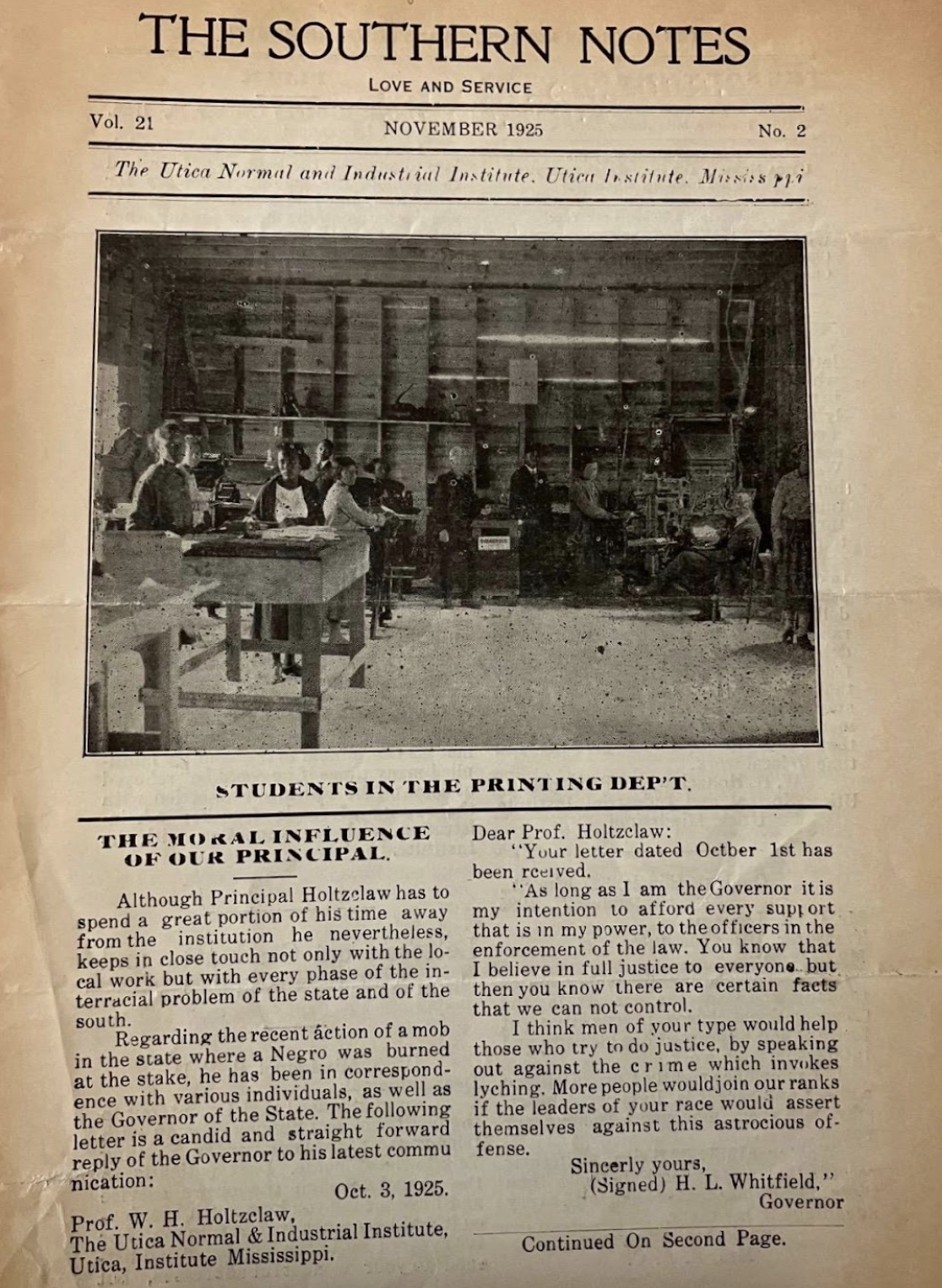
[IMAGE: Group photograph captioned "Students in the Printing Dep't," center of page, below masthead.]
VII. Damage & Illegibility
Text that cannot be read due to physical damage (foxing, tears, ink loss) is indicated as follows:
Each transcribed issue is saved as a plain-text UTF-8 file. File names follow the convention YEAR_vol.number_Southern_Notes_Transcript_STAGE, where the stage suffix reflects the current draft status.
All transcriptions undergo a two-stage review: a second transcriber checks the text against the source image, and a final editorial review addresses annotations and apparatus. Discrepancies are resolved by the lead transcriptions editor, with the decision recorded.
Protocol Version 1.0. This document will be updated as the project develops. Questions and suggested revisions welcome.
Publication Information
Appendix 3: Publication Information about Southern Notes — the printing history of the newsletter, its relationship to Tuskegee's publications, accession history at Harvard and other institutions, and suggestions for reading the archive.
Printing at Utica
Of the many industries taught at Utica, William Holtzclaw took a particular interest in printing and binding ("...printing was and still is very interesting to me" (BMB, 49)). He was trained in printing at Tuskegee and after graduation, set up the printing trade at Snow Hill while working on his plans to come to Mississippi. Following a pattern of community organizing that he would repeat at Utica, Holtzclaw "organized the teachers—eight in all—into a publishing company and induced each one of them to contribute a dollar out of their small wages" (BMB, 62). With these funds, together with a $10 donation from a local white planter, Holtzclaw purchased type, and the Snow Hill operation soon began to make money as local merchants sent their printing work to the Institute. Holtzclaw also edited and published a weekly community newspaper while at Snow Hill and for a short time experimented with a daily newspaper in what he called the first Negro daily paper in Alabama.
Printing, of course, played a large part in Tuskegee's success as well. Booker T. Washington operated many publications to disseminate word about his work to his various audiences. Holtzclaw worked on many of those issues during his time in the Printing Office. Like The Southern Workman published by Hampton Institute beginning in 1872, Tuskegee's The Southern Letter and The Tuskegee Student, along with later publications like The Negro Farmer, were among the publications Washington used to promote the Tuskegee model.
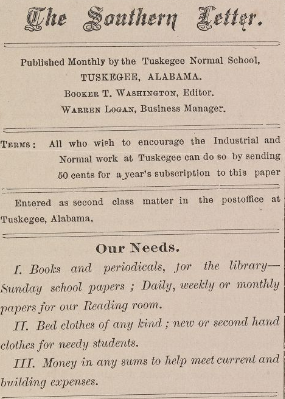
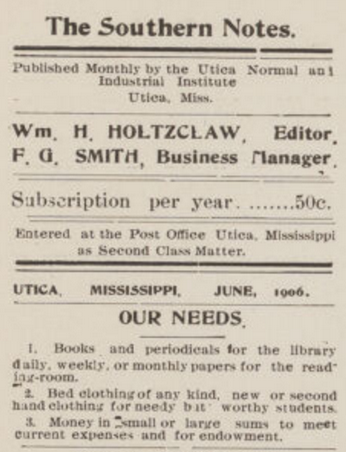
At Utica, Holtzclaw published The Southern Notes primarily for donors around the country and Utica News for alumni and local supporters. These papers were "published by the Literary Department and printed at the printing shop owned by the Institution and operated by students" [Dec. 1917, p. 4]. Southern Notes was clearly patterned after Tuskegee's Southern Letter. Aside from the similar title, Southern Notes uses a masthead inspired by The Southern Letter (see "Our Needs" in figures 1 and 2) and a similar focus on promoting the activities of the school to a wider audience.
Figure 1. The Southern Letter vol. 4 no. 7, November 1887Figure 2. The Southern Notes vol. 4 no. 8, June 1906
Volume Numbering
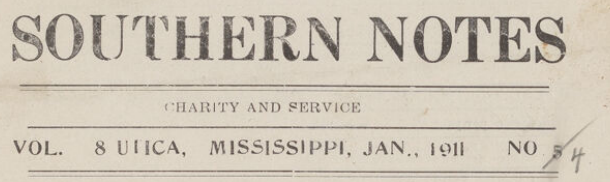
The earliest known copy of Holtzclaw's Southern Notes dates to October 1903 as volume 1, number 4, placing the probable start date of the publication as July 1903. Volume numbering usually begins in September of each year, but due to errors in printing, numbering is sometimes confused. For example, volume 8 begins in September 1909 but ends up spanning two full years with the issue in October & November 1910 restarting numbering as volume 8 numbers 1 & 2 (numbering errors in that case might have been introduced due to a series of devastating tornados which hit the campus in July 1910). Harvard librarians corrected some numbering in pencil when the collection was accessioned (see figure 3), but due to missing issues in the archival record, it can sometimes be difficult to determine if those issues are truly missing or if those issues were skipped at publication. In this collection, we are following the corrected numbering for ease of archival reference.
Figure 3. Harvard numbering correction during accessioning shown in pencil on November 7, 1923.
Transcription and Editing Process
Most of the surviving issues of Southern Notes are held at Harvard. Much of the Harvard collection came to the institution via Harvard President emeritus Charles William Eliot, and other Harvard-affiliated scholars (see "Why a full archive?" below for additional information on the accession history). The collection for this book has been assembled from that collection with issues to fill in the collection where possible from scattered individual issues held at the University of Mississippi, Tulane University, Trinity College, and the New York Public Library. In one instance, a missing issue was reconstructed from a reprint in Hampton's Southern Workman [July 1935].
Using digitized images from the archives, our transcription process was a first-pass OCR machine transcription using ABBYY FineReader and Google Pinpoint, accompanied with manual correction of each page into a working document. Student interns Malique Smith and Javon Rose at the Utica Institute Museum created a second transcription and any differences between the first and second versions were flagged for manual review by the editors. Our transcription protocol faithfully preserved the text as-printed, aside from removing end-line hyphenation. Spelling, case, and punctuation was otherwise preserved, with unclear or missing text marked in brackets. From that "faithful" transcription, we created the newly typeset version appearing in this text. Following Holtzclaw's decision to print student letters as received to highlight the need for education, we are continuing that practice in this edition. In this edition, for ease of reading, we have pulled articles together which continued on following pages in the original newspaper. After the first instance, repeated sections of text, such as the list of needs and the standard one-column profile of the school, have been removed in our version as well.
Suggestions for Reading Southern Notes
William Holtzclaw's story and that of the Utica Institute is primarily known through Holtzclaw's 1915 autobiography, Black Man's Burden. That text, among the earliest published by an African American in Mississippi, provides an invaluable historical record of the struggles of one of Booker T. Washington's students to start a "little Tuskegee" in rural Mississippi. However, there has been a gap in the historical record from the publication of Holtzclaw's book in 1915 to his passing nearly 30 years later. Reading Southern Notes, with descriptions of Holtzclaw's month by month challenges and celebrations, provides that missing public story. In fact, nearly every issue of the newspaper reveals new information. One of our favorite discoveries in the text has been the many stories of Utica graduates who went on to form an entire ecosystem of "little Uticas" — dozens of schoolhouses across Mississippi in places like Panther Burn, Learned, and Cayuga built on the Hampton/Tuskegee/Utica model.
We can imagine several ways to read Southern Notes in addition to those we mention in the Introduction. We think every reader will enjoy the experience of reading large sections of the text and stopping periodically to marvel at the rapid growth of the institution and the perseverance of William and Mary Ella Holtzclaw, the Utica teachers and students, and the Utica community to see this institution take form. Another way to read the text is with an eye toward future areas of research. We are very excited about the many areas of research this archive opens. We do our best in this text to point to some of those areas and we're sure that readers will find many more. We trust that this text will find a warm reception in today's classrooms as an exciting primary source. Finally, William Holtzclaw's own first steps were shaped by Booker T. Washington's call to bring education into the deepest, darkest corners of the world. We hope that readers will find in Holtzclaw's monthly writings a similar source of inspiration as we work to make our world more just.
Why a Full Archive?
As Michel-Rolph Trouillot reminds us in Silencing the Past, archives are not neutral storehouses of the past but sites where power produces both history and silence. He argues that these historical silences are found at four moments: the creation of sources, the assembly of archives, the retrieval of facts into narrative, and the assignment of retrospective significance. To follow Trouillot's framing, we are fortunate that William Holtzclaw controlled his own press and distributed his writings widely to his supporters, shaping the moment of fact creation on his own terms. Yet, as is true with many HBCU archives, original materials at the Utica Institute were later lost to fires (whether accidental or arson), natural disasters, changes in governance, shifting institutional priorities, and budgets too thin to support sustained archival care. At these moments of loss and neglect, silence has entered the historic record.
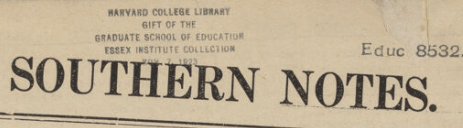
Southern Notes entered the historical record because Holtzclaw sent issues to people in power, who deemed the publication important enough to catalog and preserve in institutional collections. The accession records of Southern Notes at Harvard provides a glimpse into some of those supporters. Most of the early issues were added to Harvard's collection in November 1923 as part of the Essex Institute Collection, a literary and scientific society in Salem, Massachusetts (figure 4).
Figure 4. Library accession stamp reflecting the Essex Institute Collection.
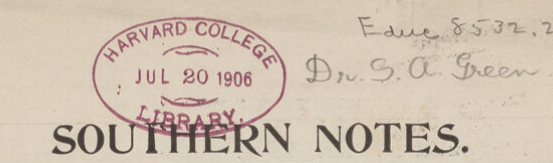
However, there are occasional issues in Harvard's archive which were accessioned individually. For example, the June 1906 issue was donated to the Harvard Library on July 20, 1906 by Dr. Samuel A. Green, a Harvard-trained physician who later was active in historical studies and was serving as vice-president of the American Antiquarian Society at this time.
Figure 5. Southern Notes masthead with gift note from Dr. S. A. Green, vol. 4, no. 8, June 1906.
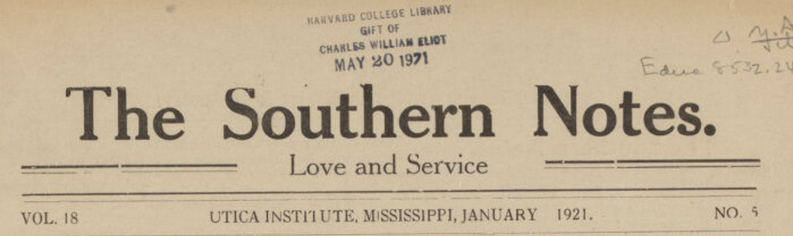
Starting in the 1920s, many of the issues were donated to Harvard by president-emeritus Charles William Eliot and Professor A. C. Coolidge, the first director of Harvard's library.
Figure 6. Southern Notes masthead with gift stamp from Charles William Eliot, vol. 18, no. 5, January 1921.
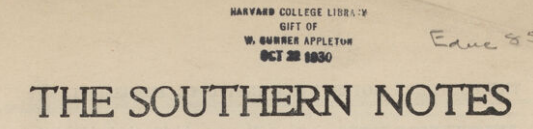
Following Eliot's death in 1926, many of the later issues were donated to the Harvard Library by Harvard-educated preservationist William S. Appleton, founder of the Society for the Preservation of New England Antiquities.
Figure 7. Southern Notes masthead with gift stamp from William Sumner Appleton, vol. 24, no. 5, February 1929.
Holtzclaw likely crossed paths with these Harvard-connected folks during his summer visits. Like many Black educators in the Jim Crow era, Holtzclaw frequently attended the Summer School at Harvard: "Principal Holtzclaw spent ten summers at Harvard University, taking special work in education" [Nov. 1920].
Southern Notes survives not simply because Holtzclaw produced and circulated it, but because institutions of power recognized it as legible, valuable, and worthy of archival care. Presenting the archive in its entirety helps counter the silences that institutions and chance have imposed, allowing Southern Notes to speak as fully as possible to its readers and historians alike.
Work in Progress
This is a Pre-Publication Mockup
This page is a working draft prepared in advance of the book's publication by the University Press of Mississippi.
The cover image shown is a placeholder and will be replaced with the final artwork. Links to preorder the book will be added when available.
If you've arrived here unexpectedly, you're welcome to look around — the site is simply not yet in wide circulation.
About the Project
A Record of Self-Determination
Southern Notes was begun in 1903, as one of two monthly newsletters by the Utica Normal and Industrial Institute: Southern Notes was written for supporters of the institution around the country, while the Utica News was for students, alumni and the local community. For nearly four decades Southern Notes captured everything from construction of new buildings and sewing room donations to the daily struggle against inequality in Jim Crow Mississippi.
In this collection, we find accounts of the day-by-day challenges and victories of this "little Tuskegee" in rural Mississippi. This edition seeks to recover that record in full.
"Our aim is to establish, as far as possible, a self-supporting industrial and normal training school." — W. H. Holtzclaw, 1903
Preorder
Coming Soon
Preorder information will be available closer to publication. Check back soon!